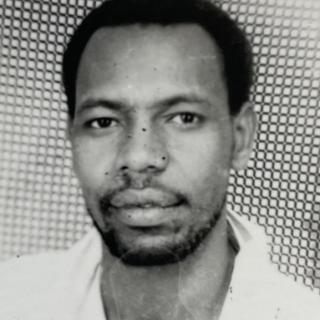
We remember Albert Rutazibwa
Albert Rutazibwa was born in 1959 in the city of Gisenyi, north-western Rwanda. He went to Gacuba primary school in Gisenyi (1966–1973) before attending a teaching institute (1973–1978) in Zaire, the former Democratic Republic of Congo. After finishing his studies, Albert worked as a taxi driver in Gisenyi from February 1983 to November 1986. He then worked as a truck driver for a Chinese construction company in the city.
In July 1987 Albert moved to the Rwandan capital Kigali to take up a position as driver and guide for the Rwanda Travel Service. He was tailormade to be a tourist guide: he spoke five languages –Kinyarwanda, French, English, Swahili and Lingala – and loved interacting with people. He worked there until January 1991 when he lost his job following the outbreak of civil war in Rwanda. In December that year Albert applied for work at the ICRC delegation in Kigali. In his application, Albert said he had first heard of ICRC founder Henry Dunant while a Scout at school. He also revealed a compassionate side, saying that whenever he saw someone in distress, he “felt their pain”.
Albert joined the ICRC in May 1992 as an administrative field officer. He quickly became a popular member of the Kigali delegation, committed, motivated and always on hand to help out. Indeed, nothing was too much for him, whether buying goods, delivering mail or getting repairs carried out. If you wanted something done, Albert was the person you turned to.
He made such a positive impression in such a short space of time that in August 1993 he was promoted to the position of dissemination field officer, tasked with raising awareness of the ICRC’s mandate and respect for the laws of war. He organized dissemination campaigns with the military, church leaders and schools. And when the president of the ICRC visited Rwanda, who else but Albert was chosen to drive him around.
In early 1994 Albert was looking forward to travelling to Geneva to attend a training course at ICRC headquarters when Rwanda’s president Juvénal Habyarimana was assassinated on 6 April. The killing triggered the start of the Rwandan genocide in which hundreds of thousands of people would be massacred. Albert had been due to fly out of Kigali on 9 April, but the airport was closed in the wake of the assassination.
On 18 April, Albert joined a team of international ICRC delegates who were being evacuated by road from Kigali to neighbouring Burundi. Unfortunately, the border had been closed to Rwandan citizens, and only the international staff were able to cross. His colleagues said they had no choice but to leave Albert behind a few hundred metres short of the frontier. It was the last time that he was seen alive. Albert was 35 and married with a three-year-old daughter.
In life, there are some people who are born to make a difference. Albert was just such a person – intelligent, charismatic and full of initiative. In his short ICRC career, he had made himself an indispensable part of the Kigali team. He was, in the words of others, an “exceptional” colleague. He had a bright future ahead of him.
The ICRC in
Rwanda, 1994
The ICRC’s humanitarian activities in Rwanda in 1994 can be divided into two distinct periods: the first three months and the rest of the year. On 6 April the country’s president was killed in a plane crash and a horrifying wave of massacres swept the country, killing hundreds of thousands of civilians. Armed militia groups led by extremist politicians systematically set about eliminating anyone who did not support their cause, principally people of the Tutsi ethnic minority, but also moderate Hutus. The prime minister was executed in the first few days of the violence, along with the United Nations soldiers guarding her. Other moderate members of the government soon suffered the same fate. The capital Kigali was plunged into total chaos. Killings, generalized looting and lawlessness were the order of the day.
The ICRC’s immediate decision was to stay on – we were the only international humanitarian organization to remain in the country – and set up emergency surgical care for the survivors of the massacres. As they were located in the heart of the combat zone, our delegation and hospital in Kigali came under shellfire on several occasions and a number of patients and staff were killed. While massacres were sweeping the parts of the country controlled by the government, the Rwandan Patriotic Front (RPF) resumed the internal armed conflict and launched a military offensive on 8 April from the territory it already controlled in the north, gradually moving southwards and eventually overrunning the entire country.
In addition to the vast population movements prompted by the massacres, the advance of the RPF caused the displacement of much of the Rwandan population, which had numbered some seven million before April. We responded to the new needs, deploying logistic and budgetary resources on a scale that made the Rwanda operation our largest relief operation worldwide in 1994. At the end of the year around two million Rwandan refugees were still living in camps across the borders with Zaire (now the Democratic Republic of Congo), Tanzania and Burundi, and a further 500,000 people displaced within the country had not yet returned to their homes.
One of the ICRC’s principal raisons d’être is the protection of civilians in times of armed conflict, and the fact that our delegates remained on the spot during the massacres in Rwanda undoubtedly helped spare many lives. Among those protected in this way were about 50,000 people gathered in pockets around Kigali and other towns; they were visited regularly by delegates who brought them food and other essentials. But the total number of lives lost puts this initially impressive figure into perspective. In the second quarter of 1994, all semblance of respect for human life and dignity was abandoned in Rwanda. Civilians were deliberately targeted in an organized genocide and men, women and children were massacred on a horrifying scale. Atrocious acts were committed, sometimes in blatant disrespect of the red cross emblem. On 14 April, Red Cross ambulances were stopped on their way to hospital by armed militias who then shot dead the patients inside; children were slaughtered at the orphanage in Butare on 1 May; Kigali Central Hospital was shelled on 18 May.
Our delegates took up and maintained contacts with as many people of influence as possible, both military and civilian. The remaining authorities were constantly urged to put an end to the genocide and reminded of their responsibilities. Special emphasis was given to the protection of groups of people at high risk, who had sought refuge in places such as Amahoro Stadium, the Sainte Famille church, the Mille Collines hotel (all three in Kigali), in Kabgayi and in the stadium in Cyangugu.
As soon as the bloodshed began in Rwanda, the ICRC moved swiftly to ensure a comprehensive response. Our delegations in Burundi and Kenya became focal points for the relief operation and offices were set up in Ngara, over the Tanzanian border, and in Kabale, on the Ugandan side. Meanwhile, additional staff were sent to our office in Goma (north-eastern Zaire), which had been set up over a year beforehand to follow the situation in Rwanda; a new office was opened in Bukavu, in South Kivu.
As hundreds of thousands of people fled the killings, land and crops were abandoned and food became scarce. Access to clean water also became a major problem for displaced people. We did our best to distribute emergency food rations, but as people kept moving, especially in the first few weeks of the crisis, this proved to be extremely difficult in some areas. Nevertheless, a great deal of aid was quickly distributed, especially in central and northern areas and in the south-west of the country. By the end of June our teams had distributed some 6,000 tonnes of food to around half a million people.
As the international community became aware of what was going on in Rwanda, a number of organizations began evacuating unaccompanied children to other countries. The ICRC’s tracing agency stepped in to assume the role of central data bank for information concerning these children. By the end of the year, 37,000 unaccompanied children had been registered in cooperation with the UNHCR, UNICEF and non-governmental organizations.